Categories
Architecture Community

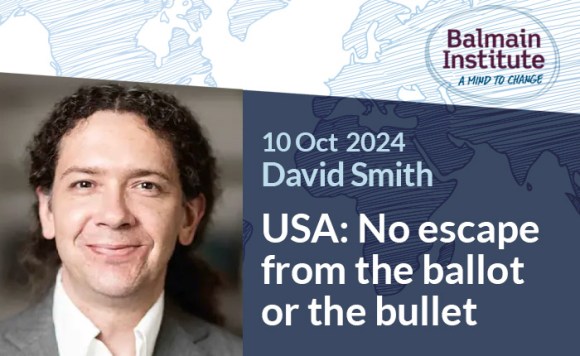
David Smith

America 2024: No escape from the ballot or the bullet

Why do so many Americans still support Donald Trump, who is enjoying his highest approval ratings ever? Given that Kamala Harris has proven to be such a better candidate than Joe Biden, why did it take so long for her to emerge as one?
And what are the prospects for serious social unrest in the United States, regardless of the election outcome?
Is the country, as many suggest, on the verge of falling apart?

The answers to all these questions lie in the great paradox of American politics: American political parties are weak, often futile organisations that command strong, sometimes violent loyalties. Understanding why this is the case may not fill you with hope for the future, but it may help you make sense of the madness.

About David Smith

David Smith is the Associate Professor of American Politics and Foreign Policy. David is jointly appointed between the US Studies Centre and the School of Social and Political Sciences at the University of Sydney. 

Smith has a PhD in political science from the University of Michigan and a BA from the University of Sydney. His research examines political relations between states and minorities, with a focus on religion in the US.

EXPERTISE: Australia-US relations, US politics and elections, Gender, race and religion, US foreign policy, defence and strategy.
more about David

Categories
Architecture Community

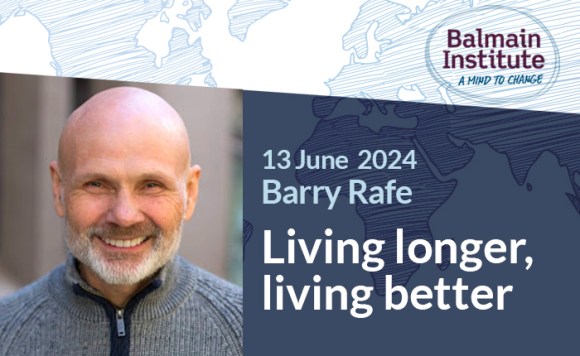
Barry Rafe

Living longer, Living better: exploring the science and social impact of increased longevity

Over the past century, average life expectancy has doubled, largely due to advancements in healthcare and public health measures. Despite global pandemics, obesity, and the opioid crisis impacting mortality rates, overall mortality continues to improve. This prompts the question: could someone alive today be the first to reach the age of 200? Additionally, what factors contribute to our increased longevity, and is there a natural limit to how long humans can live?

Join Barry Rafe as he reviews current research on longevity, exploring factors influencing mortality differences among population groups, such as gender and socioeconomic status. Contrary to expectations, populations with the largest increase in longevity have also exhibited slower population growth. Barry will look at global population growth and projections. He will also briefly touch on some of the social implications of longevity trends. 

about Barry Rafe

Barry brings a wealth of knowledge to this topic.  He is a former president of the Actuaries Institute, and has experience as a director, CEO and consultant. Barry presents courses on board governance, strategy and finance for the Australian Institute of Company Directors (AICD). As a Fellow of both the Actuaries Institute and AICD, Barry is highly respected in his field. He has contributed to the body of knowledge through the publication of several research papers on topics including longevity and board governance. Beyond his academic and professional pursuits, Barry is also a skilled presenter and entertainer. He frequently speaks at conferences and serves as an MC for various events. Interestingly, he has honed his presentation skills on the stand-up comedy stage, having performed at numerous comedy clubs in Sydney and even competed in and won rounds in the national Raw Comedy competition.

more about Barry

Categories
Architecture Community

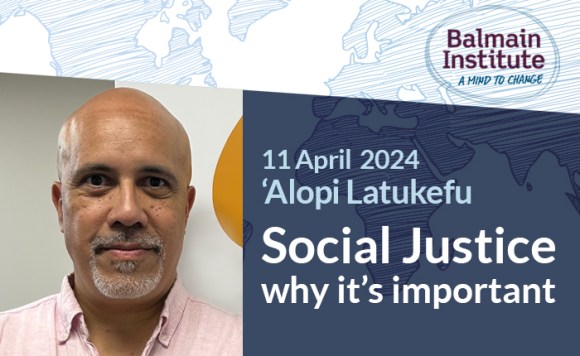
‘Alopi Latukefu

Social justice – why it’s important

‘Alopi Latukefu is the Director of The Edmund Rice Centre for justice and community

‘Alopi will share how the centre works to promote human rights, social justice and eco-justice through research, community education, advocacy and networking.

The Centre’s traditional priority areas have included Indigenous People and Reconciliation, Refugees, People Seeking Asylum and Pacific Island people affected by climate change. 

Edmund Rice Centre

about ‘Alopi Latukefu

‘Alopi has a diverse career including 17 years in the Commonwealth Government working on Australia’s aid, foreign policy and economic diplomacy agendas. His last job with DFAT was looking after global education scholarships including the Australia Awards program.
‘Alopi was also CEO of Goolarri Media in Broome and held roles in the University sector including with the National Centre for Development Studies at ANU and the Australian Graduate School of Management at UNSW.

more about ‘Alopi

Categories
Architecture Community

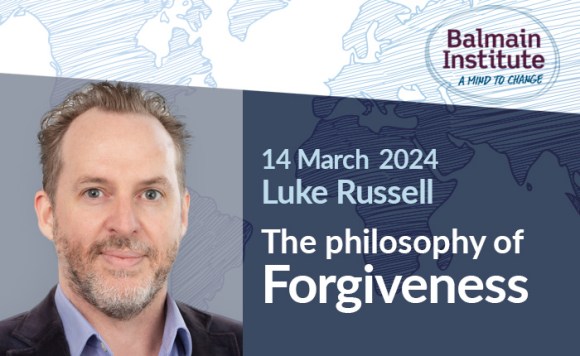
Luke Russell

The philosophy of Forgiveness

You should forgive those who have wronged you, or so we are often told. In this talk we will delve into the philosophy of forgiveness to see whether we can figure out what it means to forgive.

Christians say that unconditional forgiveness is a generous gift that heals the wounds created by wrongdoing. Therapists tell us to forgive so as to move on from the burden of resentment and regain our own happiness. But might it sometimes be unwise to forgive an unrepentant wrongdoer? To answer these questions, we first need to know exactly what forgiveness is supposed to be. Unfortunately, it seems that we cannot agree on a definition. 

about Associate Professor Luke Russell

Luke has a BA (Hons) and a PhD in philosophy at the University of Sydney,  where he now teaches ethics and critical thinking. Luke’s main area of research is moral philosophy. He has focused on questions concerning evil, virtue and vice, and forgiveness and has published several books and numerous papers on these and other related topics. 

more about Luke Russell

Categories
Architecture Community

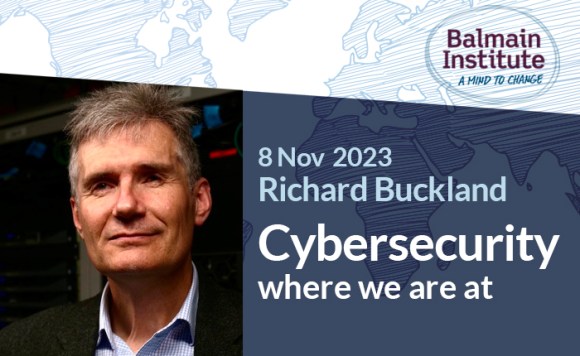
Richard Buckland

Cybersecurity – where we are at

Richard will give an overview of the current state of cybersecurity, structural reasons why we expect systems to remain vulnerable to attack into the foreseeable future, and extrapolate current and emerging trends.

Issues discussed will be how citizens can best make themselves cyber secure, which official advice is useful and which is less useful, and how we can help our friends family and community.  We’ll explore issues including trends in privacy and the Australia card 2.0, tradeoffs between security and the impact on individuals, electronic voting, information warfare and foreign influence, and the challenges faced by governments and civil society.

About the Speaker

Richard Buckland is Professor in CyberCrime Cyberwar and Cyberterror at the School of Computer Science and Engineering UNSW, Visiting Professor in Educational Design at the National University of Malaysia UKM, and Grand Challenge Visiting Professor in CyberSecurity at Taylors University.

more about Richard

Categories
Architecture Community

Lara Calder

Urban co-living

ageing with choice

Lara will outline the concept of co-living, using built examples of co-living communities and will then hone in on the process needed to deliver customised co-housing developments in Sydney’s Inner West.

Agency Cohousing and Community is co-hosting this event.
Louise Silburn from Agency will give a local perspective on cohousing initiatives in the Inner West.

About the Speaker

Lara Calder is the Managing Director of Calderflower Architects. With a focus on innovative and sustainable architecture, Lara champions her team to challenge the conventions of aged care, seniors living and community design. 

Lara is passionate about delivering and positively influencing the future needs for the care and accommodation of the elderly and fostering their social relationships within our communities.

Coming from a professional background in healthcare, Lara brings first-hand experience in the field and uses her experience and deep understanding of the needs of the elderly to design successful projects. She also participates in research projects and sits on various committees relating to aged care and seniors housing design. She has presented her own research and ideas at conferences throughout Australia and the world.

more about Lara Calder

Categories
Environment

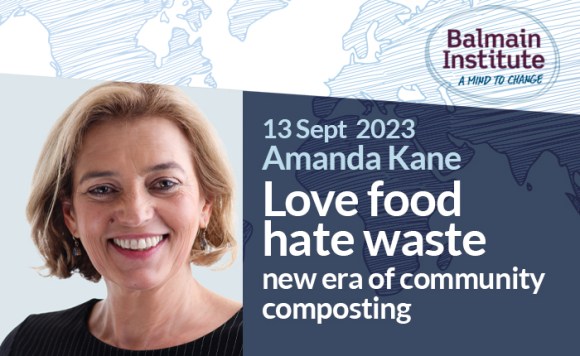
Amanda Kane

Love food hate waste

The opportunities of food waste from global to local

Food waste generates 8% of global greenhouse gas emissions and costs Australia $36 billion a year. In landfill it generates emissions and yet is a valuable resource that can be used to generate energy, improve soil health or feed chickens. Amanda will outline the challenges for NSW as it shifts to separating food waste and the steps being taken to get there. 

About the Speaker

Amanda Kane

Amanda is the Organics Manager for the NSW Environment Protection Authority (EPA). Having delivered a $100 million program to make organics recycling a truly circular system in NSW, Amanda and her team are currently working on the design and delivery of new programs to deliver on commitments for net zero emissions of organics waste from 2030.

Find out more about
SCRAP TOGETHER
 
Community education program run by the EPA helping councils make the most of FOGO (Food Organics / Garden Organics).

Categories
Uncategorized

Helen Carter

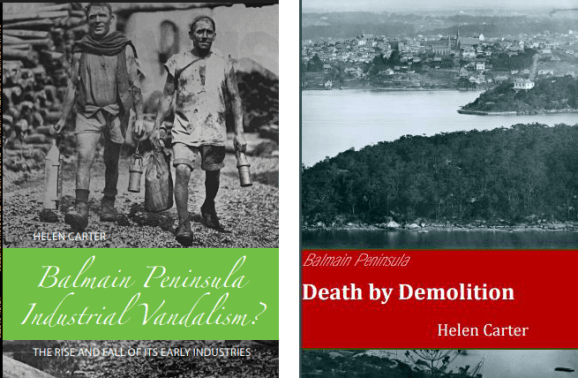
Death by demolition

Lost houses and industrial heritage of the Balmain peninsula

Join local researcher and author Helen Carter for fascinating insights from her two books into the vanished houses of Balmain, Birchgrove and Rozelle, as well as the Balmain peninsula’s lost industrial heritage. Her talk includes photographs, advertisements and plans that help visualise these early buildings and industries, together with the lives of their owners, occupants and business owners.

About the Speaker

Helen Carter – Author of the Balmain Peninsula series, Death by Demolition and Balmain Peninsula – Industrial Vandalism?, has lived in Birchgrove for 30 years. Her studies in Australian history at the University of New South Wales, together with her love of old houses and Australian 19th century photography, provided the ideal background for the writing of these two books.

All proceeds to the Balmain Association for the preservation of the Watch House in Darling Street, Balmain.

more about the Balmain Association

Categories
Uncategorized

Robert Tickner

Jailing is failing and so is youth detention

Time to turn to evidence based alternatives which break the cycle of incarceration

The Justice Reform Initiative is a new national organisation which seeks to shift the public conversation and public policy in Australia away from building more and more prisons and youth detention centres and instead to turn to evidence based alterneratives which break the cycle of offending and turn lives around.

Australia spend almost $6 Billion each year just in operational costs of prisions and youth detention centres. This does not address the underlying issues giving rise to contact with the criminal justice system by many people including a massively disproportionate number of First Nations people. We need to invest instead in mental health and substance dependency programs, employment, housing, literacy, family violence prevention and other drivers of contact with the criminal justice system.

About the Speaker

Robert Tickner AO is Australia’s longest serving Minister for Aboriginal and Torres Strait Islander Affairs and among other things was the Minister who co-ordinated the national response to the Royal Commission into Aboriginal Deaths in Custody. During his time in the portfolio, he fought hard for Indigenous rights and wrote about his experiences in his book “Taking a Stand”.

Prior to his election to the national parliament Robert worked as a solicitor with the Aboriginal Legal Service in Redfern. After political life Robert was CEO of Australian Red Cross for ten years and acted as the Under Secretary General of the International Red Cross and Red Crescent Federation in Geneva. Robert has also published another book titled “Ten Doors Down” which outlines his journey to find his birth family as an adopted person.

more about Robert Tickner AO

Categories
Uncategorized

Pathways to carbon neutral communities

In partnership with the Balmain Association

PANEL DISCUSSION
Pathways to carbon neutral communities

A carbon neutral community is one that makes no net contribution of C02 to the atmosphere. In this meeting we will take a broad look at what this might entail. The meeting will take the form of a panel discussion led by Sarah Dingle, well known journalist and ABC presenter.

Sarah Dingle is a dual Walkley Award-winning investigative reporter and presenter with the ABC, working across radio and TV current affairs, news and documentary.

Read more about Sarah

The panel

Contributors to the discussion include Gavin Gilchrist, Project Manager, Inner West Community Energy; Kate Wild, Award-winning current affairs and investigative journalist; Michal Levy, Artist and Environmental activist,  both with the Sydney Alliance, and Dr Margaret Vickers, Science Educator, and Inner West Community Energy/Community Batteries.

The topics

1. Australia’s electricity supply system is undergoing a revolution, as renewables (PV solar, wind, hydro etc) start to replace coal fired power plants. 
A large proportion of our future power input will come from rooftop solar panels, but this is creating a challenge for those who manage the grid and the electricity supply system. Rooftop solar input is a ‘wild card’ and at present, on a sunny day, there may be more power entering the network than the system can manage. When this happens, the solar power is discarded, or ‘curtailed’. Community batteries can take up this otherwise wasted energy and store it, releasing it to the grid at night time. 
This strategy provides the rationale for the Labor government’s plan to install 400 community batteries across the nation.

2. Energy efficiency- especially in relation to low-income rental properties
Many Australian homes are very poorly insulated, leading to a massive wastage of energy.  We are just beginning to see the uptake of very efficient smart appliances such as fridges, washing machines, ovens, cook tops, reverse cycle water heaters and air conditioners, etc. However, approximately one-third of all Australians live in low-income rental or community or public housing. Their units are almost always poorly insulated and poorly maintained.
This represents both a significant equity issue. Without insulation, without approptiate maintenance and without efficient appliances, our poorest citizens are now paying the highest power bills. Recent research indicates that household income and power bills are inversely correlated! (The lower your income, the more you pay for gas and electricity).  
This collection of problems also represents a serious gap in our overall emissions-reduction strategy.

Categories
Uncategorized

Elizabeth Farrelly

In partnership with the Balmain Association

The Power of Beauty – or what we can learn from Balmain

We are richer and freer than ever, yet we continue to make cities that few of us like. Now, they threaten our very survival. Cronyism, uglification, sprawl, heritage destruction, misappropriation of public land, flogging of public assets, carbon emissions, habitat clearing and urban heat: at the heart of them all lies a fallacy; the idea of city as profit-machine rather than a ground of shared connection. Perhaps it is time for a reset.
What, asks Dr Elizabeth Farrelly, can we learn from old, unplanned and beloved environments like Balmain.

About Elizabeth

Elizabeth Farrelly is a columnist, essayist, novelist, critic and speaker. Trained in architecture, science and philosophy, she is fascinated by how humans engage with nature to make culture. Over thirty years her Sydney Morning Herald column on urbanism, planning, planting, climate, politics and public art has seen city-making go from back-page news to headline material. With a PhD in Sydney urbanism, Farrelly has been Assistant Editor of the Architectural Review in London, a City of Sydney Councillor, Associate Professor (Practice) in the Australian Graduate School of Urbanism at the University of NSW and inaugural chair of the Australia Award for Urban Design.

More about Elizabeth

Categories
Architecture

Tim Sneesby

Community engagement & town planning: putting the public interest back into planning

Meaningful engagement with the planning system can be an impossible task for many members of the community. Planning decisions can often seem to reflect the desires of industry and not those of the local community.

In this talk, Tim will reflect on the challenges facing communities in influencing NSW Government planning policy decisions, as well as how residents can meaningfully engage with the planning system at a local level – both strategic planning and development assessment. Tim will also discuss the creation of a new Community Planning Advocate role that Waverley Council has recently sought to establish.

About Tim Sneesby

Tim Sneesby is a manager of strategic planning at a Sydney council and an honorary senior lecturer at the University of Sydney. He was recently seconded to the Greater Cities Commission to assist with a vexed metropolitan planning policy of industrial lands. He has worked in an urban economics consultancy in Sydney, as a planner in London and throughout his career has worked with developers. He is a recipient of the Planning Institute of Australia’s National Young Planner of the Year award. His views are his own.

Categories
Education

Georgie Dent

Early childhood education: pathways to social and economic reform

Australia lags the developed world in educational outcomes, child wellbeing, women’s workforce participation and gender equity.

All this could be changed by creating a comprehensive and effective early childhood education and child care system. This would mean:

  1. Children would not be at risk of falling behind when they start at school
  2. Impediments to women’s labor force participation and career advancement would be greatly reduced

Inaccessible or unaffordable early childhood education and care adversely affects the daily lives of countless families.

In this presentation, Georgie Dent will explore why this policy transformation answers – at once – a number of Australia’s most pressing economic and social challenges.

About Georgie Dent

Georgie Dent is a writer, author, former lawyer and leading advocate for women’s empowerment, gender equality and families. She is the executive director of The Parenthood, a not-for-profit advocacy organisation representing 72,000 parents and carers around Australia, and a contributing editor of Women’s Agenda.
 
She is a regular television commentator on The Drum, The Project, The Today Show, ABC Breakfast News and has appeared on Q&A, Weekend Sunrise, Studio 10 and Sky News. Her best-selling memoir, Breaking Badly, was published by Affirm Press in May 2019. She lives in Sydney with her husband and their three daughters.

more about Georgie Dent

Categories
Environment

Chris Gambian

11 August 2022

Nature is for everyone – and needs us all!

Chris will make the case for more people – a wider array than those who might see themselves as greenies – understand what nature means to them in their lives, and taking a role in protecting it.
In addition, environment organisations need to be more proactive about reaching diverse communities in the fight to make conservation a high order public policy issue.

About Chris Gambian

Chris has been a trade unionist, community organiser and campaigner for over 25 years. He’s also been an NGO board member and the Labor candidate in the Federal seat of Banks in the 2016 and 2019 elections.
Since 2019 he claims he has had the extraordinary privilege to lead the Nature Conservation Council of NSW, an organisation that represents over 180 conservation organisations in NSW as an effective and powerful voice for nature.

More about Chris

chrisgambian.com.au

chris gambian facebook

Categories
Asylum seekers

Frances Rush

14 July 2022

Asylum seekers: towards a better future

Frances will provide an overview of the work of the Asylum Seekers Centre, the challenges many people seeking asylum face and the opportunities that arise from the newly elected government.

There are currently thousands of people seeking asylum living in Australia, awaiting the outcome of their application for refugee recognition. While they wait, people seeking asylum usually have a temporary visa which in most cases allows them to work and access Medicare. They are excluded, however, from accessing income support from the Federal Government, and from accessing resources from many other state and federal agencies.
People seeking asylum are valuable members of our communities, workplaces and schools, and Australia would be much richer if they were treated equitably and enabled to contribute more.

About Frances Rush OAM

Since becoming CEO of the Asylum Seekers Centre in 2015, Frances Rush has ensured the continued stability and growth of the Centre. 
Frances has over thirty-five years of experience as a social worker in both the government and community sectors as well as a wealth of experience in advocacy and policy development. Her diverse public sector career includes senior executive roles with the NSW Department of Justice in Guardianship where she worked in advocacy and policy across government as well as the ageing and disability sectors. Prior to commencing with ASC Frances worked with the Royal Commission into Institutional Responses into Child Sexual Abuse.

Categories
Foreign Affairs Politics

Bates Gill

9 June 2022

China’s global ambitions under Xi Jinping

Increasingly powerful, prosperous and authoritarian, China under the leadership of Xi Jinping has become a more intense competitor across the globe – economically, technologically, militarily, and in seeking to influence people’s hearts and minds.
But what does China ultimately want in the world?

In this timely and illuminating talk, internationally renowned China scholar and local author Dr Bates Gill will discuss the fundamental motivations driving the China’s more dynamic, assertive and risk-taking approach to the world under Xi Jinping. 

Drawing from his current book, Daring to Struggle, he will address such issues as China’s convoluted stance on the Ukraine crisis, its likely actions against Taiwan, prospects for China’s economic future, U.S.-China relations, China’s efforts to change how we think about world order, and what it all means for Australia.

Daring to Struggle is available from Oxford University Press

About Bates Gill

Dr Bates Gill has a 30-year international career as an institution leader, policy advisor, consultant, and educator focusing on China. He is a Professor and Head of the Department of Security Studies and Criminology at Macquarie University, inaugural Scholar in Residence with the Asia Society Australia, and Senior Associate Fellow at the Royal United Services Institute in London.

Categories
Politics

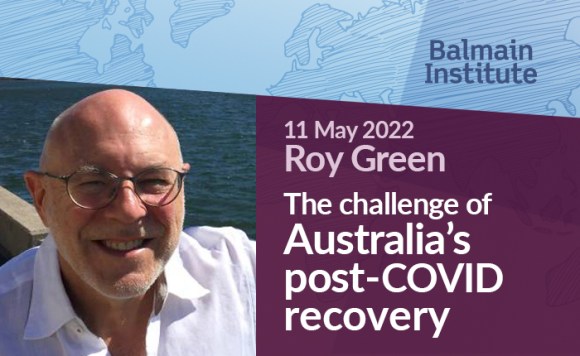
Roy Green

11 May 2022

The challenge of Australia’s post-COVID recovery

Roy Green argues a post-COVID recovery must go beyond a one-off economic stimulus and address some fundamental questions about our outdated industrial structure.
He says relying on a commodity based economy will saddle us with long term productivity and wage stagnation. We would be better off to focus on building competitive advantage in the knowledge based industries of the future.

About Roy Green

Roy is Emeritus Professor at the University of Technology Sydney, where he was Dean of the UTS Business School.
He has a PhD in Economics from the University of Cambridge and has published widely in the areas of innovation and industry policy, including projects with the OECD and European Commission.
Currently, Roy chairs the Advanced Robotics for Manufacturing Hub and Port of Newcastle, and he is a board member of the Innovative Manufacturing Cooperative Research Centre and Australian Design Council.
He was recently asked to join the NSW Modern Manufacturing Taskforce.